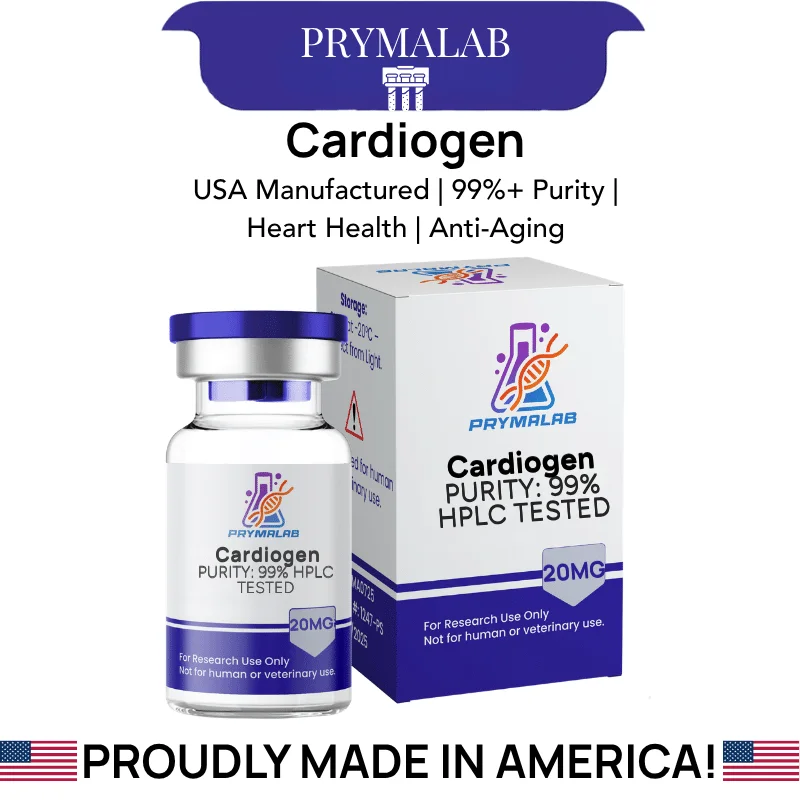
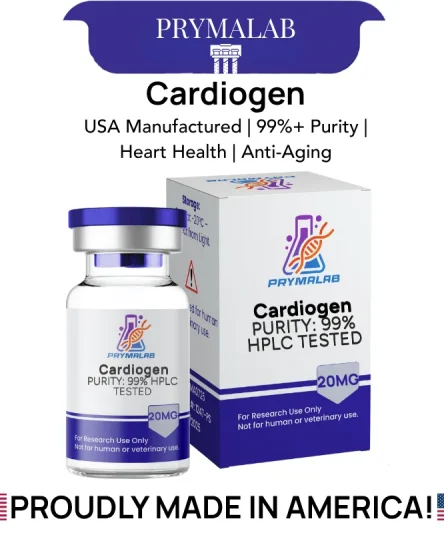
Cardiogen peptide is a lyophilized vial of the tetrapeptide Ala-Glu-Asp-Arg, written AEDR, the heart-directed compound in the Khavinson bioregulator range. The terminal arginine makes it the most basic member of the family, which has consequences for handling that its relatives do not share.
Specification Table
Cardiogen chemical and handling data
| Property |
Value |
| Compound |
Cardiogen |
| Sequence designation |
AEDR |
| Amino acid sequence |
Alanine-Glutamate-Aspartate-Arginine |
| Sequence provenance |
Secondary sources, converging. Not traced to a single primary citation. Confirm against the lot certificate before relying on it for calculation |
| Residue count |
4 |
| Molecular weight, calculated |
489.5 g/mol, computed from standard residue masses plus water rather than quoted from a paper |
| Net charge at neutral pH |
Net positive, one strongly basic residue against two acidic |
| Most basic residue |
Arginine, guanidinium group, pKa approximately 12.5 |
| Oxidation-prone residues |
None |
| Chromophore |
None. Concentration cannot be determined by 280 nm absorbance |
| Compound class |
Short peptide bioregulator, cytogen subclass |
| Source tissue of the parent fraction |
Cardiac tissue |
| Originating programme |
St Petersburg Institute of Bioregulation and Gerontology |
| Proposed mechanism in the literature |
Sequence-specific interaction with DNA, modulating tissue-associated gene expression |
| Mechanism status |
Hypothesis. Not independently established outside the originating programme |
| Receptor |
None identified |
| Appearance |
White lyophilized powder |
| Purity |
Per lot-specific certificate of analysis |
| Solubility |
Water soluble |
| Storage, lyophilized |
2-8°C or -20°C, protected from light and moisture |
| Regulatory status |
No approved human or veterinary formulation in any jurisdiction |
What Does the Terminal Arginine Change?
Cardiogen peptide is the only compound in this range ending in arginine, and that residue behaves differently from everything else in the family.
Arginine carries a guanidinium group with a pKa around 12.5, which means it stays protonated and positively charged across the entire pH range any laboratory works in. Lysine, the other basic residue in this family, has a pKa nearer 10.5 and can begin to lose its charge at high pH.
The practical consequence is that Cardiogen holds a net positive charge under essentially all conditions, where its relatives sit near neutral or negative.
That changes surface adsorption. Basic peptides bind to the negatively charged surfaces of ordinary glass and plastic, and the loss is proportionally larger at low working concentrations. Low-binding consumables matter more here than for any other bioregulator.
It also changes counterion load. Trifluoroacetate associates preferentially with basic residues, so a guanidinium group is a strong binding site and this peptide carries more counterion per mole than its neutral relatives.
Chromatographically the arginine adds retention on ion-exchange and can cause peak tailing on reversed-phase silica through interaction with residual free silanols, which is worth knowing before reading a purity figure.
What Is a Heart Bioregulator?
The organ phrasing outdraws Cardiogen peptide in search and it names the programme premise rather than a pharmacological category.
Khavinson and colleagues fractionated organ extracts on the idea that each contains short peptides carrying tissue-specific regulatory information, then named the resulting compounds after their source organ.
Cardiogen came from cardiac tissue in that work. The name records where it was found, not where it has been shown to act.
The family divides into cytomaxes, which are tissue extracts of unknown composition, and cytogens, which are defined synthetic sequences. Cardiogen is a cytogen and can be fully characterised by routine analysis.
Claims established for a cardiac cytomax preparation therefore do not transfer to Cardiogen, and secondary sources interchange the two categories routinely.
No tissue-distribution study across this family appears in the published record, which is the study that would justify or retire the organ naming across all sixteen compounds at once.
What Cardiogen Peptide Dosage Figures Are Published?
The figures below are amounts from published studies in the species those studies used.
Published rodent studies occupy the microgram per kilogram band by parenteral routes, which is consistent right across the Khavinson range.
The Russian clinical record lays out ten to twenty day courses at tens to low hundreds of micrograms, structured as blocks rather than continuous exposure.
That schedule is reported alongside the quantity in the primary descriptions and dropped from most secondary summaries, which is how a course-based figure gets misread as a daily one.
No receptor affinity is known, so wide concentration ranging is a requirement rather than a refinement.
Allometric scaling through body surface area is required for cross-species work, and the FDA publishes the conversion factors.
What Cardiogen Peptide Benefits Have Been Measured?
The published Cardiogen peptide benefits endpoints are narrower than the phrasing implies, and the gap is worth naming.
Work from the originating programme reports cardiac tissue observations in aged rodent models, including histological assessment and markers of tissue-associated gene expression.
Cell-culture work across the family reports chromatin decondensation, advanced in support of the DNA-binding hypothesis rather than of any organ-specific claim.
No well-powered independent Western clinical trial exists for this compound. That absence characterises the entire bioregulator literature rather than this compound specifically.
The settled chemistry, the documented research record and the unresolved mechanism are three separate things, and merging them is what produces overclaiming in this area.
What Should Cardiogen For Sale Documentation Show?
Cardiogen peptide at four residues is simple to characterise, and the arginine makes two fields more important than usual.
Measured mass against roughly 489.5. That figure is calculated from residue masses rather than quoted from a paper, so read the certificate figure as the measurement.
Counterion identity with net peptide content, weighted more heavily here than elsewhere. The guanidinium group binds trifluoroacetate strongly, so the correction on this compound runs larger than on its neutral relatives.
Purity by reversed-phase chromatography with the column chemistry stated. Peak tailing from silanol interaction is common with basic peptides and it is a method artefact rather than an impurity.
Sequence stated explicitly as Ala-Glu-Asp-Arg. Cortagen, Cardiogen, Bronchogen and Epitalon all share Ala-Glu-Asp and differ only at the terminal residue.
Concentration cannot be checked at 280 nanometres, since there is no aromatic residue. Quantitative amino acid analysis, or a colorimetric protein assay, is what works instead.
How Does Cardiogen Peptide Compare With Its Direct Relatives?
Four compounds share Ala-Glu-Asp and differ only at the terminal residue, which makes them the cleanest comparison set in the family.
Cortagen ends in proline, which rigidifies the terminus and obstructs carboxypeptidases, and cardiogen peptide ends in arginine, which adds a permanent positive charge. Bronchogen ends in leucine, adding hydrophobicity. Epitalon ends in glycine, maximising flexibility.
Those four terminal residues span most of the chemical property space available: constrained, charged, hydrophobic and flexible.
If the programme claim holds, four compounds identical at three of four positions should address four different tissues. If it does not hold, all four should behave much the same.
That is about as clean an experimental design as a compound family ever hands a researcher, and the material cost of running it is negligible.
Cardiogen peptide is the natural positive control within that set, because its arginine gives it a physical property the other three lack and therefore a plausible mechanism for behaving differently for reasons unrelated to tissue specificity.
How Should Cardiogen 20mg Be Handled?
Cardiogen peptide at twenty milligrams and roughly 489.5 daltons is approximately 40.9 micromoles, a large molar quantity for this range.
No cysteine, no methionine, no tryptophan and no asparagine-glycine motif, so the usual degradation routes are unavailable.
Store dry powder sealed against light and moisture at 2 to 8 degrees Celsius or below.
Use low-binding consumables at working concentrations. This is the one bioregulator where adsorptive loss is a realistic concern rather than a theoretical one, because the net positive charge binds to ordinary surfaces.
Water solubility is good. Introduce diluent gently along the vial wall and swirl instead of shaking.
Log the lot, the measured mass, counterion, net peptide content, diluent, volume, resulting concentration and every date.
A last note on the counterion arithmetic. Because arginine binds trifluoroacetate more strongly than the neutral residues, two vials of nominally identical mass can differ in actual peptide content by more here than elsewhere in the family.
That makes net peptide content less of an administrative field and more of a real correction, and it is the number to build a concentration on.
Where a supplier will not state it, a rough check is available: acetate-exchanged material weighs measurably less per mole of peptide than trifluoroacetate salt, so asking which salt form was supplied narrows the uncertainty even without a number.
A closing observation on the four-way comparison. Because the alanine series spans constrained, charged, hydrophobic and flexible termini, it is arguably a better test bed for peptide structure-activity work generally than it is for the tissue claim it was built around.
Four short peptides identical at three positions, differing systematically at the fourth, cheap to buy and chemically stable, is a teaching set as much as a research one.
Whatever one concludes about bioregulator theory, the compounds themselves are unusually well suited to asking basic questions about how much a single terminal residue can change.
Very few compound families offer that combination, and this one does almost by accident.
A final practical note on the salt form question. Acetate and trifluoroacetate are the two forms in common circulation for short peptides, and they behave differently in cell culture.
Residual trifluoroacetate has documented effects on cell viability at concentrations that can arise from a heavily loaded basic peptide, which makes the salt form a real experimental variable for Cardiogen rather than a purchasing detail.
Acetate-exchanged material costs more and removes that confound. For a basic peptide used in culture it is usually worth the difference.
It is one of the few places in this catalogue where paying more for a salt form is straightforwardly justified rather than a matter of preference.
Published Literature
References verified against the publisher record. As across the family, this literature originates almost entirely from one research programme.
- Khavinson VK, Malinin VV. Gerontological Aspects of Genome Peptide Regulation. Karger, Basel; 2005.
- Khavinson VK. Neuroendocrinology Letters. 2002;23(Suppl 3):11-144.
- Anisimov VN, Khavinson VK. Critical Reviews in Oncology/Hematology. 2010;74(1):46-66.
- Fedoreyeva LI, Kireev II, Khavinson VK, Vanyushin BF. Biochemistry (Moscow). 2011;76(11):1210-1219.
- Khavinson VK, Solovyov AY, Zhilinsky DV, Shataeva LK, Bandaletova TY. Bulletin of Experimental Biology and Medicine. 2012;153(4):500-505.
Frequently Asked Questions
What is Cardiogen peptide?
A lyophilized vial of the tetrapeptide Ala-Glu-Asp-Arg, written AEDR, the heart-directed compound in the Khavinson bioregulator range. A laboratory research reagent only, approved nowhere for any purpose.
What does the terminal arginine change?
It makes Cardiogen the only compound here with a net positive charge under essentially all laboratory conditions, and the guanidinium group has a pKa around 12.5 and stays protonated across the whole working pH range.
How does that compare with lysine?
Lysine has a pKa nearer 10.5 and can begin to lose its charge at high pH. Arginine does not, which is why Cardiogen behaves more consistently basic than the lysine-opening compounds in the family.
What is the practical consequence?
Surface adsorption. Basic peptides bind to the negatively charged surfaces of ordinary glass and plastic, and the proportional loss rises at low working concentrations. Low-binding consumables matter more here than anywhere else in this family.
Does it affect counterion load?
Yes. Trifluoroacetate associates preferentially with basic residues, so a guanidinium group is a strong binding site and this peptide carries more counterion per mole than its neutral relatives.
Does it affect chromatography?
It can. Arginine adds retention on ion-exchange and can cause peak tailing on reversed-phase silica through interaction with residual free silanols. That tailing is a method artefact rather than an impurity.
What is a heart bioregulator?
A term naming the programme premise rather than a pharmacological category. Cardiogen came from cardiac tissue during fractionation, so the name records where it was found rather than where it has been shown to act.
Does cytomax literature apply?
No. Cytomaxes are tissue extracts of unknown make-up while cytogens are defined synthetic sequences. Cardiogen belongs to the second group, and claims established for one category will not carry across to the other.
What dosage figures are published?
Published rodent studies sit in the microgram per kilogram band by parenteral routes, alongside a Russian clinical record of ten to twenty day blocks at tens to low hundreds of micrograms.
Why does the schedule get misread?
Because it is reported alongside the quantity in primary descriptions and dropped from most secondary summaries. A course-based figure then circulates as though it were a daily one.
Which certificate field matters most here?
Counterion identity with net peptide content, weighted more heavily than for the neutral compounds in this family, because the guanidinium group binds trifluoroacetate strongly and inflates the correction.
Compliance Statement
Cardiogen peptide is sold exclusively for laboratory research use. It is not a drug, food, or cosmetic product, and it is not a dietary product of any kind. It is not approved by the FDA or any comparable authority for human or veterinary use, its proposed mechanism has not been independently established, and amounts cited are figures from published studies in the species those studies used. This product is not intended to diagnose, treat, cure, or prevent any disease. It must not be given to humans or animals. Purchase is restricted to qualified researchers and institutions operating within applicable laws. All handling is the responsibility of the purchasing laboratory.











19 reviews for Cardiogen Peptide 20mg